Staking Sets
Pocket Watch Workshop
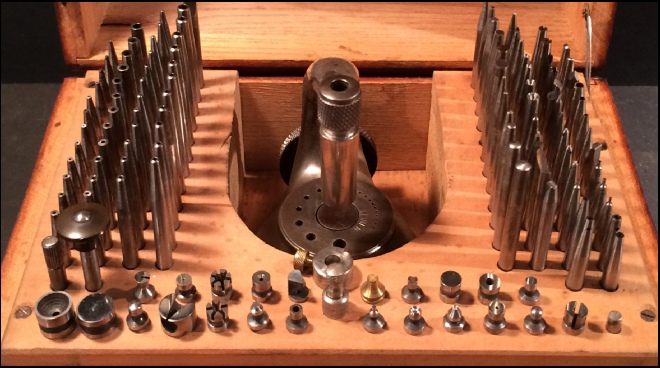
This is such a useful bit of kit that I currently have three of them!
Why are they called staking sets? Good question, because the main components are called punches and anvils (or stumps in the US). The anvils fit into various holes on the riveting plate (die plate US). The punches, in use, are held by the guiding arm.
Here are some definitions of stake:-
- a strong wooden or metal post with a point at one end, driven into the ground to support a plant, form part of a fence, mark a boundary, etc.
- historical -
a wooden post to which a person was tied before being burned alive as a punishment. - a long vertical rod used in basket-
making. - a metalworker's small anvil, typically with a projection for fitting into a socket on a bench
Looking at these definitions both the punches and the anvils could be called stakes!
Abbott defines stake as “An anvil. To fasten by means of a stake.” And he refers to the riveting plate as a “shifting table or stake”. Writing in 1898 he also goes on to add that it is “A tool needed by every watchmaker.”
Anyway, back to the thrust.
Punches and anvils are made of steel (except for special brass anvils). They are precision made and may have been tempered to different levels of hardness depending on the job they’ve been made for.
The faces of the anvils and punches are finished to an exceptionally high standard to ensure that when components (mostly brass and therefore softer) are being worked on, any chance of marring is minimised.
These days sets rarely contain more than a 120 punches or fewer than 60, although back in 1898 Abbott suggests that 24 punches and 4 stumps are more than enough. Each set will contain a centring punch which helps align the riveting plate to the guiding arm to ensure that a punch is immediately over the centre of an anvil. And most will contain a lifter; a special tool for ‘picking’ punches from the box, thus avoiding damage to the flesh from the sharper punches! Beyond this there are a myriad punches used for setting on wheels and pinions, fitting hands, truing balances, riveting, reducing holes and pipes, removing screws and pins, removing and fitting cylinder plugs, fitting rollers, removing burrs, peening and fitting cylinder shells.
There are anvils that match up with these punches to carry out the work above and other anvils to facilitate the polishing of rollers, balance staffs, balances and cylinder shells.
Special tools may also be included (or bought afterwards) for friction jewelling, reaming, milling (deburring), roller removal and balance staff removal.
A brass hammer should be used to strike the punch (a steel hammer could damage the end of the punch over time). As far as technique is concerned; it is far better to tap the punch until its work is done rather than using one, big, heavy blow!
A useful booklet to look out for is “K&D Staking Tools and how to use them . . .”. It explains what each punch/anvil does and how it’s used.
Staking sets were made by all of the specialist watchmaker tool manufacturers. In the States they have a leaning towards Kendrick & Davis and then there’s the Watch-
What to look for when buying a staking set
First things first – if any of the punches are broken beware, it is almost certainly a sign of mistreatment.
Look for a centring punch. There should be one in every set, so a missing one is a sign of carelessness.
Is there a lifter? Again, most larger sets should have one, so a sign of negligence if missing.
Take a close look at the anvils. If there is any scratching, pitting or, heaven forbid, rust then steer well clear.
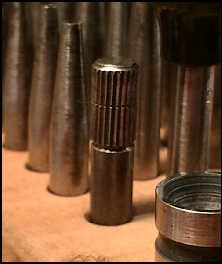
The centring punch hides, pointy end down. Every set should have one of these.
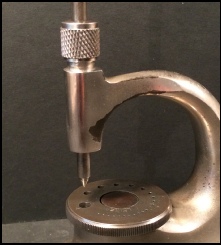
The knurled top of the guide can be twisted to hold the punch at any given distance from the riveting plate.
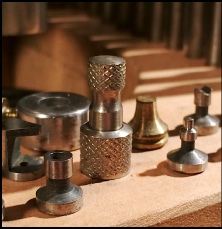
Many sets will have a ‘lifter’; a small tube that fits snugly over a punch and lets you lift the punch without damaging your fingers!
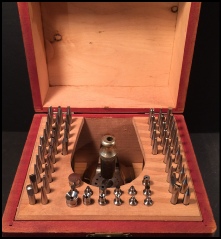
This set was made by Star. It's compact and the top of the guide the clamp is adjustable.
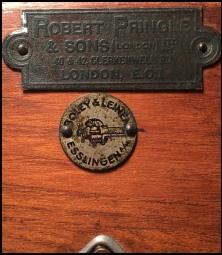
The metal label on the lid of the Leinen staking set shows it was sold by Robert Pringle & Sons. Established in Clerkenwell in 1835 it became one of the foremost suppliers to the watch and jewellery trades, closing its doors for the last time in 1967.
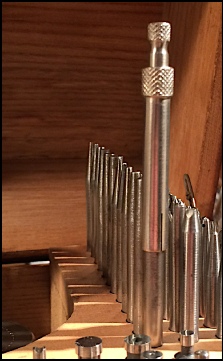
And here it is in use.
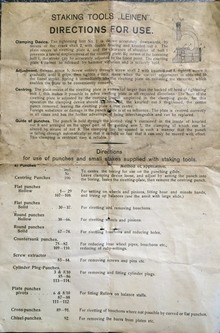
My Boley & Leinen set came with instructions for the use of the anvils and punches. Click on the picture to see them in a larger size.