Pocket Watch Workshop
From out of nowhere.
In 1859, two years before the Civil war started and ten years before the Pacific Railroad was finished, the US population broke the 30 million barrier (the UK population at the time was under 20 million) and represented a large and fast-
Watches were imported from England and Switzerland and few were made in the US; the local watchmakers couldn’t compete with the cheap imports and anyway had to import most of the parts (dial, hands etc).
Mass manufacturing seemed to be the way to go and a few brave souls gave it a whirl; among the most well-
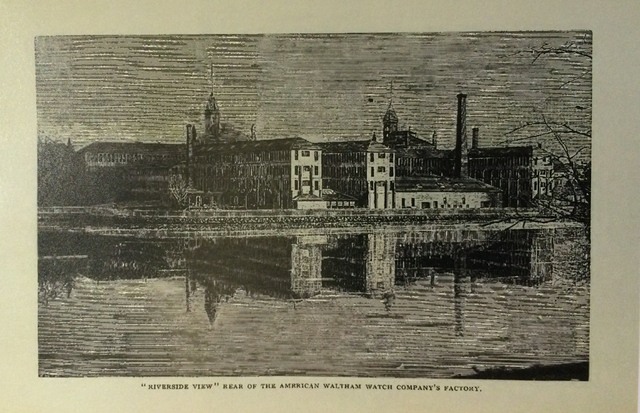
In 1849 the foundations were laid for what was to become the Waltham Watch Company and after a number of false starts and inconsistent production 1859 could be said to be the year of ‘lift off’ when the company became the American Watch Company and more than 5,000 watches rolled off the assembly line. The company closed its doors in 1957 having made some 35,000,000 watches (Elgin, the largest U.S. Manufacturer of jewelled watches, made almost twice as many in the course of its history).
Other watch companies quickly joined the booming market, among them: E Howard and Nashua. In the next decade: Newark, Elgin and Illinois. In the 1870s: Cornell, Rockford, Bulova and Hampden. And there was a mini boom in the 1880s when the railroads were expanding at a rate of 7,000 miles per year.
So what were these watches like? Well, initially, they weren’t very good at all, but as the machines that made them improved on an almost geometric scale, the watches improved in quality very rapidly.
Railroad Watches
The need for accurate and reliable timepieces on the railroads was a spur to innovation. It seems that from the 1840s, when the railroads were known to have been importing English watches, the basic requirement was that a watch should keep time to within 30 seconds a week. As the railroads expanded, became more organised and busier, the minimum requirements for a railroad watch were formalised, although in most cases this was done on a railroad by railroad basis and there was no national standard. Nevertheless watch manufacturers were keen to develop the market for railroad watches, so they tried to out vie each other with new and improved models. Of course, the benefit was that they could sell watches to the masses on the back of these railroad models. And did.
Dollar Watches
The ‘throw away’ society may well have been started by the Ingersoll brothers in the 1890s. They produced a working, reliable watch that sold for a dollar. By the turn of the century some 8,000 watches a day were rolling off their assembly lines and they could lay claim to “The Watch That Made The Dollar Famous”. Of course, these watches usually found their way into the garbage can after a two or three years, but there are many tens of thousands of survivors and many that are still working after 100 years.
Into the Twentieth Century
The American watch industry largely looked to its own markets for sales. They did export large numbers, but not in comparison to their home sales. It is not uncommon in the UK to find a Waltham in an English silver case, but it is highly unusual to see any other US movement in an English case.
But the US companies, like the English makers before them, seemed to ignore the threat from Switzerland. The Swiss had tried flooding the market with cheap watches in the latter part of the Nineteenth Century, but their watches were so much smaller and less robust than those of the indigenous makes that they caught a cold and damaged their reputation as a result. But by the middle of the Twentieth Century Swiss manufacturing, product development and marketing had improved drastically and whilst their competition had been focused on munitions production during two world wars the Swiss took advantage and captured 50% of the world market.
But it was the electronic and quartz revolutions in the 60s and 70s and cheap manufactories in Japan and China that, with only the one major exception in Bulova, put paid to the US industry and almost did for the Swiss too.
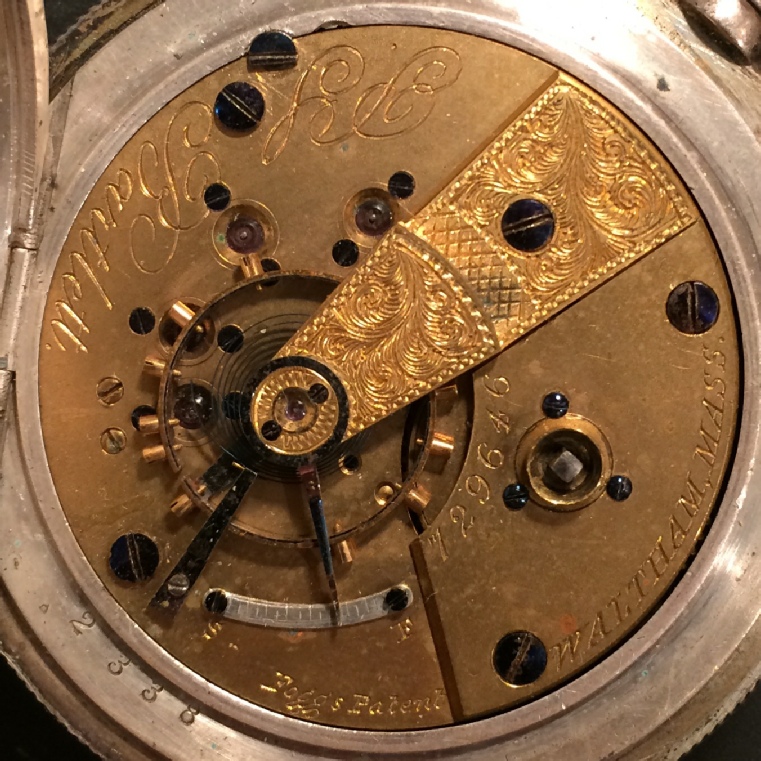
This is a Waltham 1857 model, the first, successful, mass manufactured watch to come off a production line. This particular watch was probably made in 1874 and is a size 18 (a shade under 45mm in diameter). Waltham made a variety of grades of this model each of a slightly differing quality. This is a PS Bartlett and has more jewels than the basic model and a compensation balance. Each Waltham had a unique serial number (in this case 729646) and this can be used to research further details of the watch.