Pocket Watch Workshop
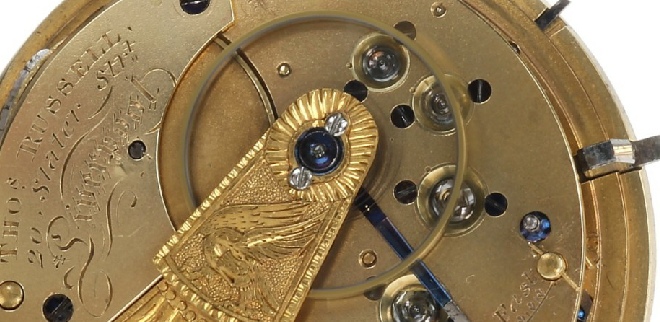
Jewelling
Diamonds, rubies and sapphires
Watch jewels have been around for over three hundred years. Before their use, the steel wheel pivots would revolve in holes in the brass plates. The wheels that moved the fastest would create the most friction and cause the biggest wear to the brass holes.
So some holes were enlarged and had jewels inserted in them; typically for the balance wheel. Diamond was too hard, difficult and costly to form, so ruby and sapphire were used (and latterly garnet). Ruby and sapphire are both forms of corundum; their different colours (and properties) result from the different impurities inherent in each stone.
Diamonds (very poor ones and cheap) were used as upper end stones on balance cocks for largely cosmetic reasons.
So jewels were harder and could last longer, but more importantly they created far less friction and therefore improved the efficiency of movements.
Jewels were also less affected by heat.
On the minus side, if they were too thin and poorly made (as many of the mass produced Swiss ones were during the latter part of the Nineteenth Century) then they were prone to break.
Natural jewels were used until 1902 when synthetic versions (still made of corundum) became available.
Jewel settings
Until the 1930s jewels were held in place by a thin bezel either directly in the plate or in a chaton (or setting, of brass or gold) which was then inserted in the plate and held in place either by friction or by tiny screws.
The bezel was strong enough to keep the jewel in place, but thin enough so that if a jewel needing replacing it could be punched out, the bezel opened slightly ready to accept a new jewel and then ‘rubbed’ closed. (However, where a brass chaton was fitted, it has always been considered best practice to make a new chaton; a gold one could be re-
In higher quality watches a screwed chaton setting was made to match perfectly the pivot it surrounded and both the chaton and the plate was marked to avoid misplacement; you may see a number of dots punched on the chaton and the same number of dots punched on the plate beside it.
A chaton setting was more expensive to produce and therefore reserved for use in better quality watches. In later years many manufacturers produced watches with plate settings dressed up to look like chaton settings, so beware!
Friction jewels
By the 1930s watches were being made in their millions; both pocket watches and the new-
It wasn’t long before someone came up with the idea of doing away with the need for bezelled settings altogether and invented a jewel that could be held in place by friction alone. Strangely his (or her) name seems to have been lost to posterity although we do know it was a Swiss innovation.
The advantages of the friction jewel were very apparent:-
- They were cheap to produce
- They didn’t need a bezel to hold them in place which brought down the manufacturing cost of the movement
- They were easy to replace
- They could be easily adjusted to provide a staff/arbour with the proper ‘endshake’
By the 1940s friction jewelling was hugely popular; as were the tools and equipment needed to replace and adjust them.
Pierre Seitz invented a comprehensive system for friction jewelling which is still in use today (now produced by Bergeon). See here.
Types of jewel
Description of shapes etc
7 jewels
By the middle of the Nineteenth Century the usual jewelling for the common lever was:-
- Balance wheel – two hole jewels, two end (or cap) stones and a jewelled roller pin (5)
- Lever pallet – two pallet stones (2)
This would be found in the typical fuse lever and the new American levers produced by Waltham
9 jewels
Jewel holes were added for the escape wheel
11 jewels
These were a bit of a cheat (found mostly in American watches). Jewel holes were added for the 3rd and 4th wheels but only on the exposed plate (the bottom plate), so viewers assumed they were paired and that the watch had 13 jewels!
13 Jewels
Watches that actually had a pair of jewels for the 3rd and 4th wheels
15 jewels
These had paired jewels to the lever, escape wheel, third and fourth wheels made
17 jewels
Jewelling of the centre wheel may be considered excessive but is often done, bringing the total of jewels to 17
19 jewels
Each end of the mainspring barrel arbour may also be jewelled to prevent wear rather than to reduce friction
21 Jewels
Cap/end stones added to lever
23 Jewels
Cap/end stones added to escape wheel
More than 23
Cap jewels added to other wheels. Totally unnecessary, but ups the jewel count!