J R Losada
Pocket Watch Workshop
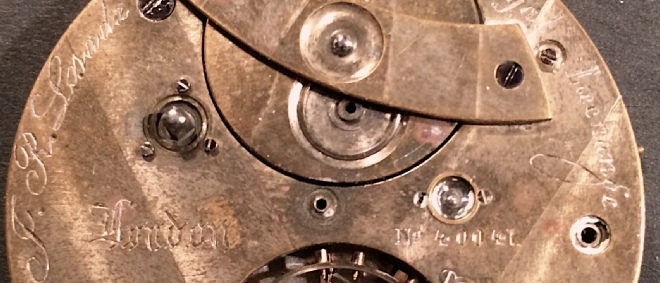
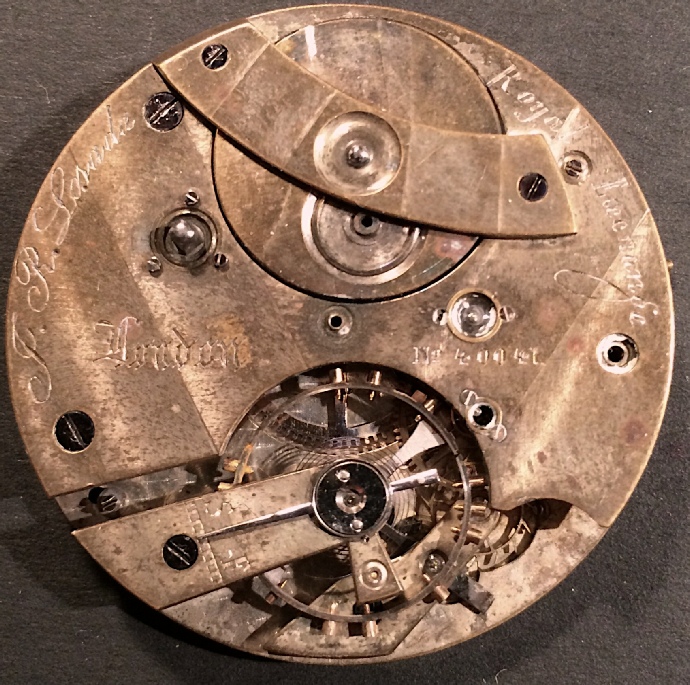
The remains of, what seemed to me, a very good watch turned up on eBay a few years ago and I bought it for a few quid. I’m not a rich man and I’d rather have a clapped out bit of quality than none at all! In one way it’s sad to see something of such pedigree in such a poor state of repair, in another I just find it amazing to think it has survived!
But who was J R Losada? One auction catalogue I read said that ‘he was Spanish, working in London, and a famous watch and chronometer maker with strong contacts with Spanish speaking markets’. Another source claimed that David Glasgow spent part of his career working for him.
I investigated.
Jose Rodriguez de Losada was born in the small, countryside village of Iruela, not far from Leon, on 8th May 1797. Early 19th Century Spain was a hotbed of political intrigue and you were in trouble if you picked the wrong side. The trouble was there were so many sides it was difficult not to pick the wrong one!
There isn’t much known about Jose’s early years, but it seems that by 1828 he was an officer in the Spanish army although nobody is quite sure how a lad from the sticks managed this. What is almost agreed is that he had to leave the country in 1828 to avoid persecution. He arrived in London (perhaps via Paris). London at that time had become a temporary home to many Spaniards who were fleeing the regime and there was apparently a very healthy émigré community in the City.
The next nine years are a bit of an unknown quantity. There are strong rumours that he became a ‘gofer’ in the watchmaking company of (Santiago) James Moore French. James Moore French had an establishment at Sweetings Alley, Royal Exchange and was a highly respected watch and clockmaker. It is claimed that, while going about his floor sweeping duties, Jose picked up discarded pieces of watch, studied them and taught himself the art of watchmaking!
What is factual is that he was in the Old Court (Old Bailey) on Friday 22nd September 1837 having accused John Byrne, a baker’s journeyman, of stealing a watch worth two pounds on 25th August. In his testimony, Jose describes himself thus: “I am a Spaniard. I am a watchmaker, and carry on business in Wayfield-
John Byrne had been delivering bread and said he wanted to buy a watch. Jose showed him one worth £4. Byrne asked if he could take it to show a friend in the trade and that he’d bring it back later. Jose agreed. Byrne didn’t return that evening. However he did come back the next day with the bread, said he wasn’t keen on the watch and was there another he could look at? Jose showed him a £2 watch, but wanted the other one back before he let go of this one. The baker’s man said Jose shouldn’t be so suspicious; he saw him every day with the bread didn’t he? After much persuasion Byrne left with the second watch. This time he didn’t return. He ran off to the pawnbroker in Ashby Street. William Robson, the pawnbroker, was in court with the £2 watch which he claimed he accepted in good faith. There was no sign of the £4 watch. Mr Sergeant Arabin judged the defendant ‘Not Guilty’.
I haven’t yet discovered a ‘Wayfield Street’, but Ashby Street leads from Northampton Square in Clerkenwell, the centre of London watchmaking.
Four years later the 1841 Post Office London Directory lists him at 20 Woburn Buildings, Tavistock Square, 11 Upper Woburn Place. ‘Up West’. And by 1852 he was at 281 Regent Street.
He became naturalised British in 1853 according to the Home Office, although it seems certain that he had always maintained many close ties with the Spanish in London and those back home. He started visiting Spain again towards the latter half of the decade and developed some very lucrative business; for example, he supplied 36 chronometers to the Spanish Government via the Royal Observatory, Cadiz.
His watch and clock business went from strength to strength. He exhibited at the 1862 London International Exhibition (and was a prizewinner for his chronometers, astronomical and turret clocks) by which time he’d moved to 105 Regent Street. Queen Isabelle II conferred on him the Merit of the Cross of Charles II and the Order of ‘Comendador de Numero’ of Isabella the Catholic. His trade card claimed he was “Maker to all the crowned heads of Europe”.
He died on 6th March 1870, aged 72. One commentator was convinced that his love of snuff and alcohol was the major contributory factor!
He left his sister in Iruela £2,500 and the business to his nephew Norberto. He also left bequests to his doctor and his servants.
The business of J R Losada continued until about 1890 at 105 Regent Street.
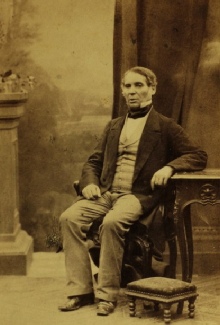
J R Losada, 1862
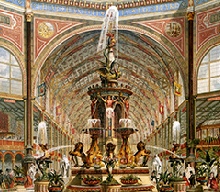
International Exhibition, 1862
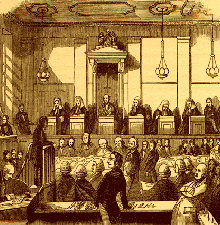
Old Bailey in the 19th Century
It’s a three-