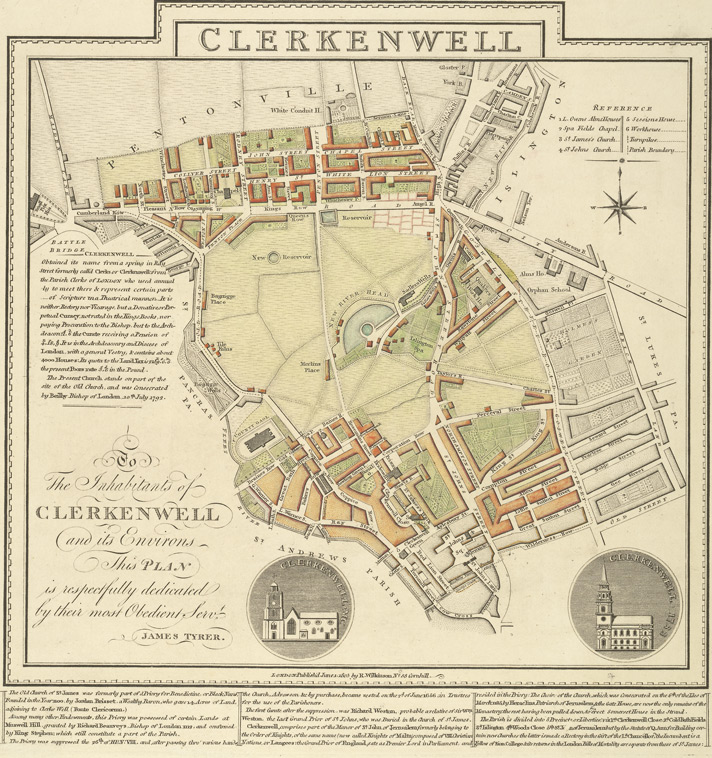
Clerkenwell
Pocket Watch Workshop
The home of English watchmaking
Rev. Nelthropp, writing in 1873, observes that with the exception of Prescot, “the whole trade of the country is within the control of Clerkenwell firms; and no matter whether in London, or Bristol, or York a watch may be sold or given to be repaired, it has at one time or other been in the hands of the Clerkenwell artisan, unless Coventry.”
It is worth mentioning here that the “trade” comprised many, many sub-
Most of these trades were undertaken in Clerkenwell where hundreds of firms (from large companies to one man bands) combined to produce over 100,000 watches a year. It must have been an extraordinary, bustling place!
But why Clerkenwell?
If there is a definitive answer I haven’t found it yet, but it seems likely that it was ‘just one of those things’.
Perhaps it was a combination of factors coming together towards the end of the Seventeenth Century:-
- a combination of low rents; Clerkenwell is just to the north of Smithfield where cattle was slaughtered and traded, and immediately to the east of what was the open sewer known as the Fleet River (now flowing underground from North to South alongside Farringdon Road).
- an influx of talented Huguenots; these were French Protestants fleeing religious persecution, some of whom were clock and watchmakers.
- and a ready market for expensive timepieces on the doorstep; Clerkenwell included and was bordered by many wealthy estates.
Whatever the origins, the industry was well established in Clerkenwell by the middle of the Eighteenth Century, was at its zenith by the middle of the Nineteenth, still alive and kicking a century later, but by the end of the Twentieth, all but dead.
The Rev. Nelthropp also mentions Prescot and Coventry.
Prescot lies to the east of Liverpool and, in general terms, produced the industry’s basic ebauches and movements. Movements (finished and unfinished) were exported to the USA, via Liverpool, for finishing, casing and onward retailing to our American cousins. Movements were also sent down to London. It is almost impossible to gauge the extent of this trade, but it must have been substantial. The area also produced finished watches, at about half of London’s production levels, whose gold and silver cases were assayed at Chester.
Coventry could be considered a centre for case and dial making and jewelling, but also produced finished silver-
To try and introduce some objectivity I have analysed Hogg’s directory of watchmakers published in 1863. The directory lists 50 different branches of the trade based in London, Birmingham, Liverpool, Manchester, Sheffield, Coventry and Prescot. Excluding the 1,000 ‘watchmakers’ which could be considered as the retail/jobbing end, there were a further 1,000 companies or individuals involved in the trade ranging from chronometer gymblers to watch finishers (see below for full details). 65% of them were based in London, 20% in Prescot and 11% in Coventry. Of course, this analysis gives no indication of the value of that trade, but it does goes some way to justifying Rev. Nelthropp’s claim.
Judging by the addresses in Hogg’s, the watchmaking trade seems to have been centred in the streets around Northampton Square. At the time of writing, this square was home to City University London, but in the early Nineteenth Century it was a rather grand place and from 1860 was home to the BHI (who moved to Upton Hall, Newark in 1972).
Today Clerkenwell is an up and coming area, increasingly residential and home to many who work in the City. I wonder how many of today’s residents have even the slightest inkling of their predecessors’ life and times?
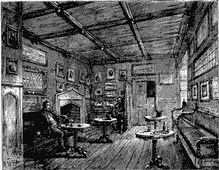
Coffee room at St John’s Gate c. 1800
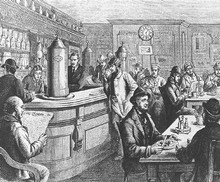
Red Star Coffee & Cocoa House, 1877
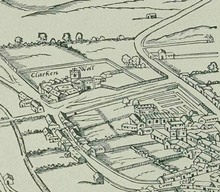
Clerkenwell, 1560
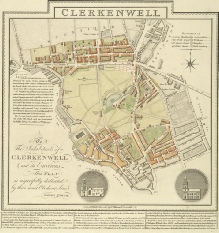
Clerkenwell, 1805
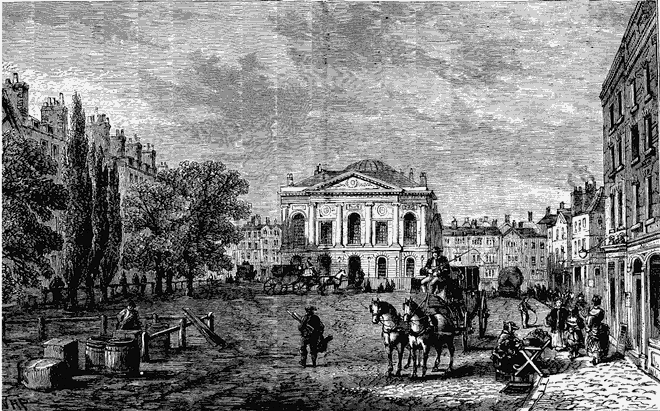
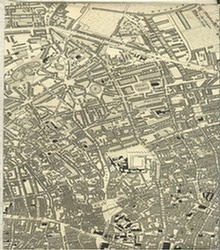
Nineteenth Century Clerkenwell. Click picture for an enlarged version.