Antoni Patek
Pocket Watch Workshop
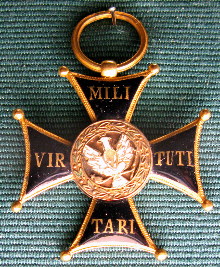
In 1833 a 22 year old young man bowled up on his own in Switzerland, via France. He had been a Lieutenant in the Polish cavalry during the 1831 uprising against Russia and had been awarded the Virtuti Militari, the Polish equivalent of the Victoria Cross.
An intelligent chap who could speak five languages, Antoni Patek began building a new life for himself in a new country. He began studying art with the famous Swiss landscape artist, Alexandre Calame and, in an effort to make ends meet, traded in anything he thought he could make money on.
Fortunately for him there was a large Polish émigré community in the country at that time and, by all accounts, his bearing and charm helped him make the most of it. He found himself dealing in watches and then developing a good business in sourcing watch movements and pairing them with cases he knew would suit the particular taste of his Polish clientele. As business prospered he commissioned cases made to his own designs.
On 1st May 1839 he took this one stage further by going into partnership with a proper watchmaker, another Pole named Franciszek Czapek. They bought ‘ebauches’ (the basic movement) and Czapek finished them (adding the train, customising the cylinder escapement and then adjusting and timing to a very high standard) before installing them in the cases. Patek sold them to his émigré market as high quality (and high value) Polish watches. Whilst there was undoubtedly more profit in ‘making’ his own watches, there was also more risk, especially as demand grew and they had to employ a workforce. Come 1844 the company was experiencing financial problems. Patek’s solution was to try and improve sales and expand away from the, by now, limiting Polish émigré market. So he took his wares off to the French Industrial Exposition being held in a temporary structure on the Champs-
This visit was to change everything for Patek . . . and Czapek. They met a very inventive and technically brilliant young French watchmaker called (Jean) Adrien Philippe who had just won a gold medal at the Exposition for his keyless wind watches. Patek could see the potential. Within a year or so Philippe had replaced Czapek and by 1850 the company was making its own ebauches (stamping a “PP” on the dial plates) and making a reputation for itself as very fine watchmakers.
I was about to say “and the rest is history”, but there are two more important characters in this story (actually there are loads more and Philip Poniz in his essay “Patek Philippe: the Forgotten Beginnings” gives a very detailed account of the early history of the company).
In 1851 another temporary structure had been erected in London’s Hyde Park and Prince Albert’s pride & joy, The Great Exhibition of the Works of Industry of all Nations, opened on 1st May. Patek was exhibiting. Queen Victoria bought a small, keyless wind watch. Prince Albert bought a Patek as well. And what with Antoni Patek’s mastery of marketing, the rest, as they say, is history!
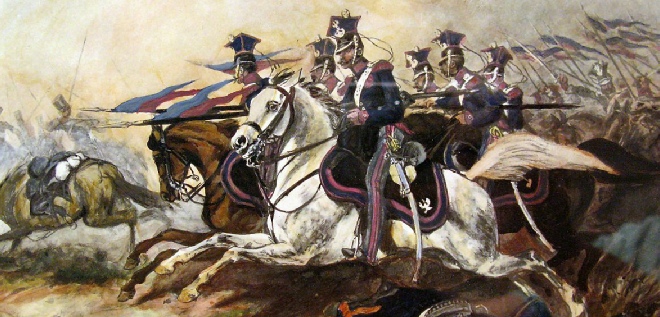
"Charge of Poznań Cavalery during November Uprising" by Juliusz Kossak -
„Virtuti Militari Cross from November Uprising 1831” autorstwa nieznany -
The Virtuti Militari, the Polish equivalent of the Victoria Cross.
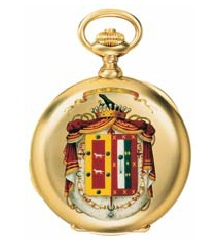
Typical of the sort of early watches sold to the Polish émigrés in Geneva.
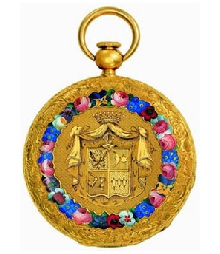
And another.
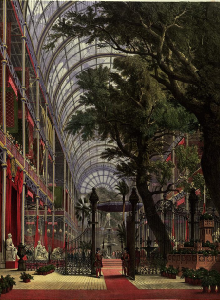
The Great Exhibition of 1851 was held in a specially created building; the enormous Crystal Palace.