Abbott, Abbott’s American Watchmaker and Jeweler
Abbott, Watch Factories of America
Abbott, Watchmaker’s and Jeweler’s Practical Hand Book
Anon, Watchmakers’ and Jewelers’ Practical Receipt Book
BHI, Horological Journal
Booth, Clock and Watchmakers’ Manual
Camm, Watches Adjustment and Repair
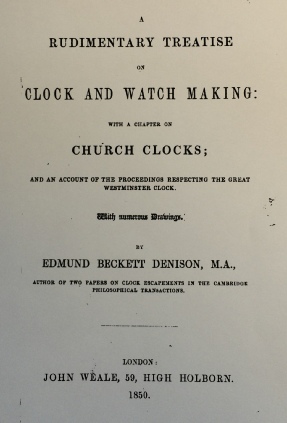
Denison, Treatise on Clock and Watch Making
Fried, Understanding the Verge Fusee Watch
Garrard, Watch Repairing
Gazeley, Clock and Watch Escapements
Glasgow, Watch and Clock Making
Goodrich, Watchmakers’ Lathe
Grafton, Horology; a Popular Sketch
Grossmann, Detached Lever Escapement
Hasluck, Watch Jobber’s Handybook
Hood, Modern Methods in Horology
Kemp, Fusee Lever Watch
NAWCC, Watch & Clock Bulletin
Nelthropp, A Treatise on Watch-
Reid, Treatise on Clock and Watch Making
Stelle, American Watchmaker and Jeweler
Saunier, Watchmakers’ Hand-
Sweazey, Chicago School of Watchmaking, Master Watchmaking
Waltham, Watchmakers’ Handbook
A Rudimentary Treatise on Clock and Watch Making
Pocket Watch Workshop
A fascinating book of 300 pages. Denison was the eventual designer of the movement for the Westminster Clock (at various times also known as the Great Clock or the National Clock). Having read mathematics at Trinity College, Cambridge, Denison went on to practise law; he was appointed QC in 1854 and retired in 1881. He was elected president of the BHI in 1868 and served in this capacity until his death in 1905 (aged 88). He also made his mark as an architect and rebuilt much of St Alban’s Cathedral towards the end of the Nineteenth Century.
This book is well written and, once you get the hang of the mid-
But what makes this book such a fascinating read is the detailed account of the ‘difficulties’ in commissioning “The Great Clock for the New Palace at Westminster” (from page 252). The scheme was proposed six years before but, at the time of writing, was mired in confusion, intrigue, recrimination, indecision and personality clashes. Denison subsequently undertook the design of the mechanism of the clock and its chiming and the Dents (Edward and Frederick) built it, completing the work in 1854. Denison later dropped the name Denison on his father’s death, becoming Sir Edmund Beckett and later Lord Grimthorpe.
Edmund Beckett Denison, 1850